


At first, the retention basin in Gargždai was planned with a single purpose in mind: preventing floods. But long-term climate projections suggest that Lithuania will not only face more intense rainfall, but also longer dry periods. So the planners decided to think a step ahead and ask how the stored water could be used – and in doing so, they turned the town into a national pioneer in water recycling.
Lithuania is not a dry country, and water is not yet a scarce resource. Anyone driving through the green summer landscape around Gargždai, near Klaipėda, can see that immediately. So why even start talking about water recycling? The answer lies in a rather inconspicuous earth embankment on the edge of town. Behind it stretches a new body of water fringed with reeds: a retention basin built for flood control – but designed to do far more.
The starting point for the pilot measure was fairly conventional. Gargždai had been experiencing increasingly frequent flooding events. Climate change was already making itself felt through heavy rainfall, and the mixed sewer system dating from Soviet times was often overloaded. A retention pond was intended to cut peak loads and enable controlled discharge. This became the entry point for Gargždai’s involvement in the WaterMan project, which explores new approaches to water management under climate change.
However, cooperation between the municipality, Klaipėda University and the association “Klaipėda Region” soon broadened the perspective. Professor Valdas Langas and his team asked a crucial question: if climate data already indicate more drought periods in the future, why not design the retention pond from the outset so that water can also be extracted and used?
From Flood Protection to National Pioneer
This shift in perspective transformed a conventional flood-control structure into a pioneering national initiative. In Lithuania, where water recycling has received little attention so far, Langas and his team became frontrunners.
“We didn’t just want to drain the water away; we wanted to treat it as a resource – to make it usable,” explains Langas.
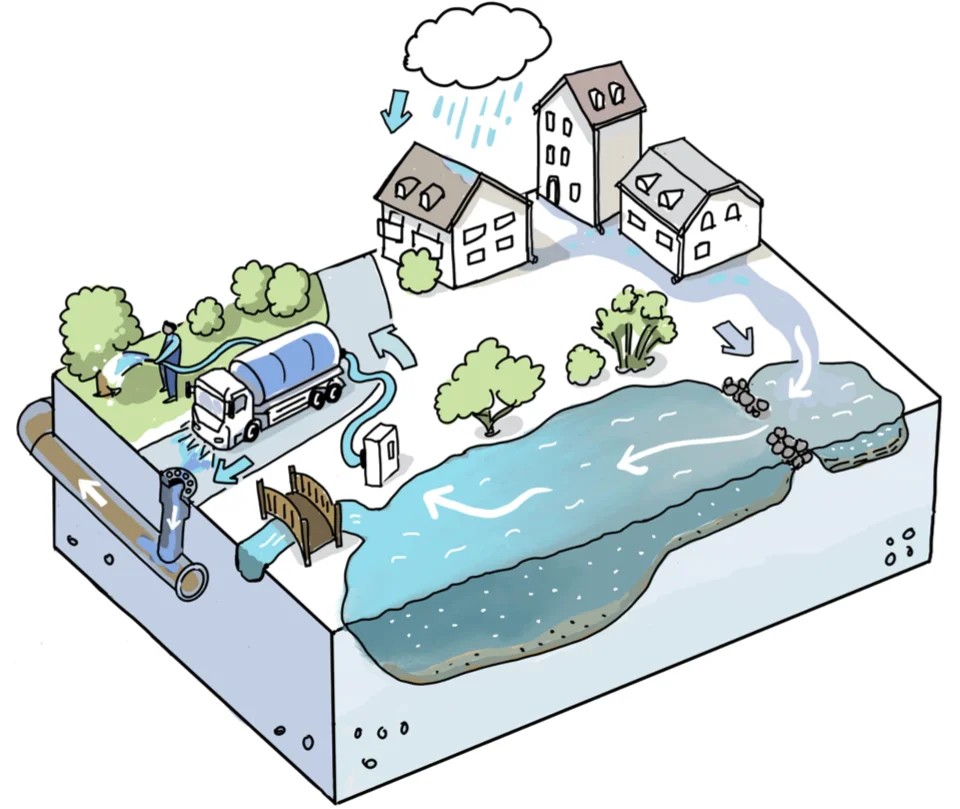
The idea was to create a multifunctional basin that protects against flooding and provides an alternative water source, for example for sewer cleaning, firefighting reserves and irrigation of parks and urban trees. At present, urban greenery in Gargždai alone consumes around 300 m³ of drinking water per year. While this may not seem dramatic, it is avoidable – and likely to become more critical as summer droughts increase.
Pioneering Work on the Legal Framework
From a technical perspective, the team benefited from exchange with WaterMan partners in Västervik, Sweden, who have long operated so-called multi-dams with extraction options. Equally important was knowledge sharing on monitoring strategies, sampling and operation.
Where Gargždai truly broke new ground was in legal terms. Water recycling is not yet clearly anchored in Lithuanian legislation. Before construction could begin, Mindaugas Šatkus and Feliksas Žemgulys from the municipality worked to establish a legal foundation for the pilot.
EU Regulation 2020/741 applies to wastewater reuse for agriculture, but rainwater and municipal non-agricultural reuse are not yet clearly regulated. Gargždai therefore had to navigate uncharted territory, raise awareness among authorities and be willing to become the first municipality to gain practical experience.
A Textbook Example of Nature-Based Treatment
Since early 2025, the retention pond has been in operation. It is located in a frequently used recreation area near a football pitch and the Jewish cemetery.
Its design follows principles of nature-based stormwater treatment. A sedimentation forebay precedes the main basin. Coarse particles settle first, while finer fractions are removed in the lower section through aquatic plants and microbial activity. This “treatment by design” approach works without energy-intensive technology.
International SuDS (Sustainable Drainage Systems) standards were used as guidance. Water quality is monitored through rainfall measurements, sampling and laboratory analyses. Results so far are promising: low nutrient levels, no relevant pathogens and no legionella. The water already meets many requirements of EU Regulation 2020/741 and Lithuanian hygiene standard HN 92:2018.
“What matters now is time,” says Langas. “An ecosystem has to establish itself. Then retention increases and future uses can be calculated with confidence.”
From Sewer Cleaning to Urban Irrigation
The first intended application is sewer network cleaning. In addition, the water will be used by municipal services to irrigate public green spaces.
Longer-term possibilities include watering newly planted trees and providing firefighting reserves. Additional UV disinfection could further broaden the range of uses, for example washing municipal vehicle fleets.
The technical implementation is manageable; building public trust will take longer. Therefore, the town is proceeding step by step.
Transparency Instead of Fences
The retention basin was deliberately built without a fence in a central, visible location. Rather than hiding water recycling infrastructure, Gargždai chose openness and transparency.
Information events, training sessions, school presentations and on-site explanations are planned. The site is intended to become a place of learning about hydrology, ecology and climate adaptation.
“This is not about compromising on quality,” emphasises Šatkus. “It is about managing resources more intelligently.”
A Low-Threshold Entry into Water Recycling
In a country where water has long been abundant, it may seem counterintuitive to invest in reuse. But climate projections clearly show increasing extremes.
Retention ponds that allow direct water extraction offer a low-threshold entry into water recycling with low operating costs. Gargždai demonstrates that it is possible to start with simple, nature-based solutions – and build from there.
“We must not lull ourselves into a false sense of security,” says Langas. “Precisely because we still have water today, we should already be learning to use it responsibly.”
Want to Learn More?
Additional information on this Gargždai pilot measure is available in the Water Recycling Toolbox, developed within the WaterMan project:
https://www.eurobalt.org/waterrecyclingtoolbox/use-cases/gargzdai-natural-stormwater-treatment-for-use-in-municipal-services/
About the “WaterMan” project
Due to climate change, periods of drought are becoming more frequent in the Baltic Sea Region, and drinking water – mainly sourced from groundwater – can become scarce. For this reason, it will be necessary to use water of different qualities and tap into additional sources of “usable water” in the future.
WaterMan (Promoting water recycling in the Baltic Sea Region through capacity building at the local level) is implemented within the Interreg Baltic Sea Region Programme 2021–2027 and supports municipalities and water companies in adapting their strategies by developing practical solutions for water recycling and recirculation. Through region-specific approaches and real-life pilot measures, the project helps make local water supply systems more climate resilient.
More information: https://interreg-baltic.eu/project/waterman/