


In Saldus in Latvia, the simple wish for a fountain in the town centre has grown into a holistic concept that combines flood protection and water recycling with an upgrade of public space. The end result is a feasibility study ready for implementation – not only in Saldus, but potentially in many other places across the Baltic Sea Region.
Anyone strolling through Saldus without expert knowledge would not suspect how closely urban design and the demands of water management are intertwined here. The central square, some historic buildings, lively paths in between, small cafés and people meeting one another – all very pleasant, but at first glance just a small town like many others. Experts, however, quickly recognise the vulnerable points. In terms of its topography, Saldus has the shape of a natural bowl. As soon as it rains heavily, water rushes down from the slopes across the main square, Kalpaka laukums, into the lower parts of the town. Within a very short time, it floods streets, pours into basements and creates emergency situations for residents and local authorities. And the outlook is not encouraging: with heavy rainfall events becoming more frequent due to climate change, such situations are likely to occur more often and become even more severe.
Over the past three years, Saldus has set out to turn these challenges into opportunities. To begin with, the thinking was by no means as comprehensive as it is today. Everything started with ideas for beautifying the town. The mayor had long had the wish to enhance Kalpaka laukums with a central fountain. It was intended not just as a design element for the townscape, but as a real contribution to the attractiveness of the town centre as a place to spend time. The fountain, together with new greenery, was to create a place of encounter where children could play in the water on hot days. Up to this point, the project was simply a classic urban development measure.
A flow of future-oriented ideas
What brought about a flow of additional, future-oriented ideas was the close cooperation between the municipality of Saldus and the Kurzeme Planning Region – and their joint participation in the WaterMan project. This opened up a completely new set of questions: why not turn the planned fountain at this vulnerable point in Saldus into the anchor of a modern, forward-looking water management approach?
Such a plan would be an opportunity to address several challenges Saldus will face in the near and more distant future at once. The increase in flooding caused by more frequent heavy rainfall under climate change is only one part of the problem. In the medium to long term, climate data suggest that this region, too, will see more frequent dry spells and periods of water scarcity. On top of that, Saldus is confronted with a challenge that almost all small and medium-sized towns face today: to keep residents and attract new ones, they need to make themselves more attractive – for example by creating inviting public spaces where people enjoy spending time.
“In Latvia, water recycling has so far not been high on the political agenda; groundwater and surface water have generally been sufficient,” says Jānis Blūms, project manager at the municipal utility. “But in the future, it will be our task to manage and balance the shift between too much and too little water at local level. That means storage, simple, low-maintenance technology – and a willingness to stop thinking of all urban water use exclusively in terms of drinking water.”
Making water recycling tangible in an emotionally charged place
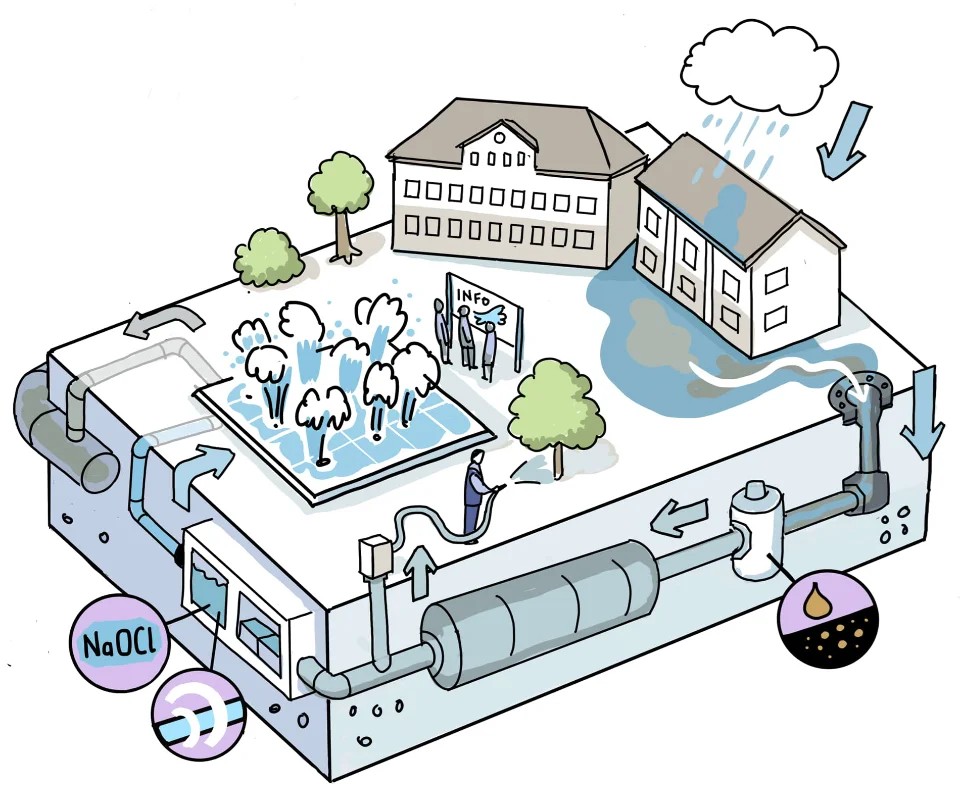
Based on these reflections, the first plans emerged for a “three-in-one” system. Rainwater that had previously flowed uncontrolled down the slope into the town was to be captured and buffered. An underground retention reservoir would absorb the surface runoff before it can cause damage. After that, the stored water could be used for irrigating green spaces or street cleaning, following UV disinfection. And of course, it would also feed the planned fountain, turning it into a powerful symbol of sustainable resource use at the heart of the town.
What Saldus has conceived here is remarkable, not least because it breaks with long-standing reflexes in urban development. A comparatively short-term political impulse was used to develop a holistic concept that goes far beyond what is visible. The fountain is not merely decorative; it is a functional part of a system that captures, stores, treats and uses rainwater multiple times. In this way, water recycling is made visible and tangible in an emotionally charged place.
At the same time, technical necessity and an upgraded public space are combined with education about a new form of water management for the Baltic Sea Region in times of climate change. The fountain becomes a teaching tool and showcase: instead of using drinking water for everything, it demonstrates a fit-for-purpose approach – using water in exactly the quality that matches the specific use.
Blūms stresses: “We want to show that water recycling is not an abstract technology, but something that works in a concrete, visible and everyday way – right in the central square of our town.”
A small setback becomes a catalyst
A few key facts and figures: technically, the concept envisages an underground retention tank with a volume of 90 m³, plus a multi-stage filtration system including UV disinfection and a monitoring system that records storage levels, water quality and water use in real time. A digital information screen on the square will explain the functioning of the system and display the main figures in real time.
Everything was looking very promising, and it seemed that construction would soon begin. But then came a setback: when the concept went out to tender, the projected costs turned out to be significantly higher than the original budget. The main cost driver was the ambitious size and depth of the underground reservoir. Faced with this, the city council decided to put the project on hold.
In Saldus, however, where the project had already gathered considerable momentum, this setback became a catalyst. Instead of abandoning the plans, the team chose to further develop and refine them. The concept was completed as an implementation-ready feasibility study – including additional potential applications for the treated water.
Sometimes willingness to learn is more valuable than prior knowledge
In refining and detailing the concept, the team benefited from peer learning with partner regions in the WaterMan project, particularly colleagues in Kalmar, Västervik and Gargždai.
What to do with winter water?
The answer was pragmatic: it could be used the following spring for street cleaning. The reservoir will be built below the frost line, allowing water to remain stored over winter.
The first dry summer will surely come
Wherever such a system is built first, it will be far more than just an attractive water feature. It represents a shift in the way we think about water management in the Baltic Sea Region.
Want to Learn More?
Additional information on this Saldus pilot measure is available in the Water Recycling Toolbox, developed within the WaterMan project:
https://www.eurobalt.org/waterrecyclingtoolbox/use-cases/saldus-stormwater-recycling-for-fountain-operation-and-greenery-irrigation/
About the “WaterMan” project
Due to climate change, periods of drought are becoming more frequent in the Baltic Sea Region, and drinking water – mainly sourced from groundwater – can become scarce. For this reason, it will be necessary to use water of different qualities and tap into additional sources of “usable water” in the future.
WaterMan (Promoting water recycling in the Baltic Sea Region through capacity building at the local level) is implemented within the Interreg Baltic Sea Region Programme 2021–2027 and supports municipalities and water companies in adapting their strategies by developing practical solutions for water recycling and recirculation. Through region-specific approaches and real-life pilot measures, the project helps make local water supply systems more climate resilient.
More information: https://interreg-baltic.eu/project/waterman/