

Full project title: Collaborative planning and pilot actions for Grey dunes restoration in the South-East Baltic
Project acronym: Dune3
Project No.: #S048
Programme: Interreg Baltic Sea Region 2021–2027
Priority: 2. Water-smart societies
Programme objective: 2.2 Blue economy
Project type: Small Project
Implementation period: 1 July 2026–30 June 2028
About the project
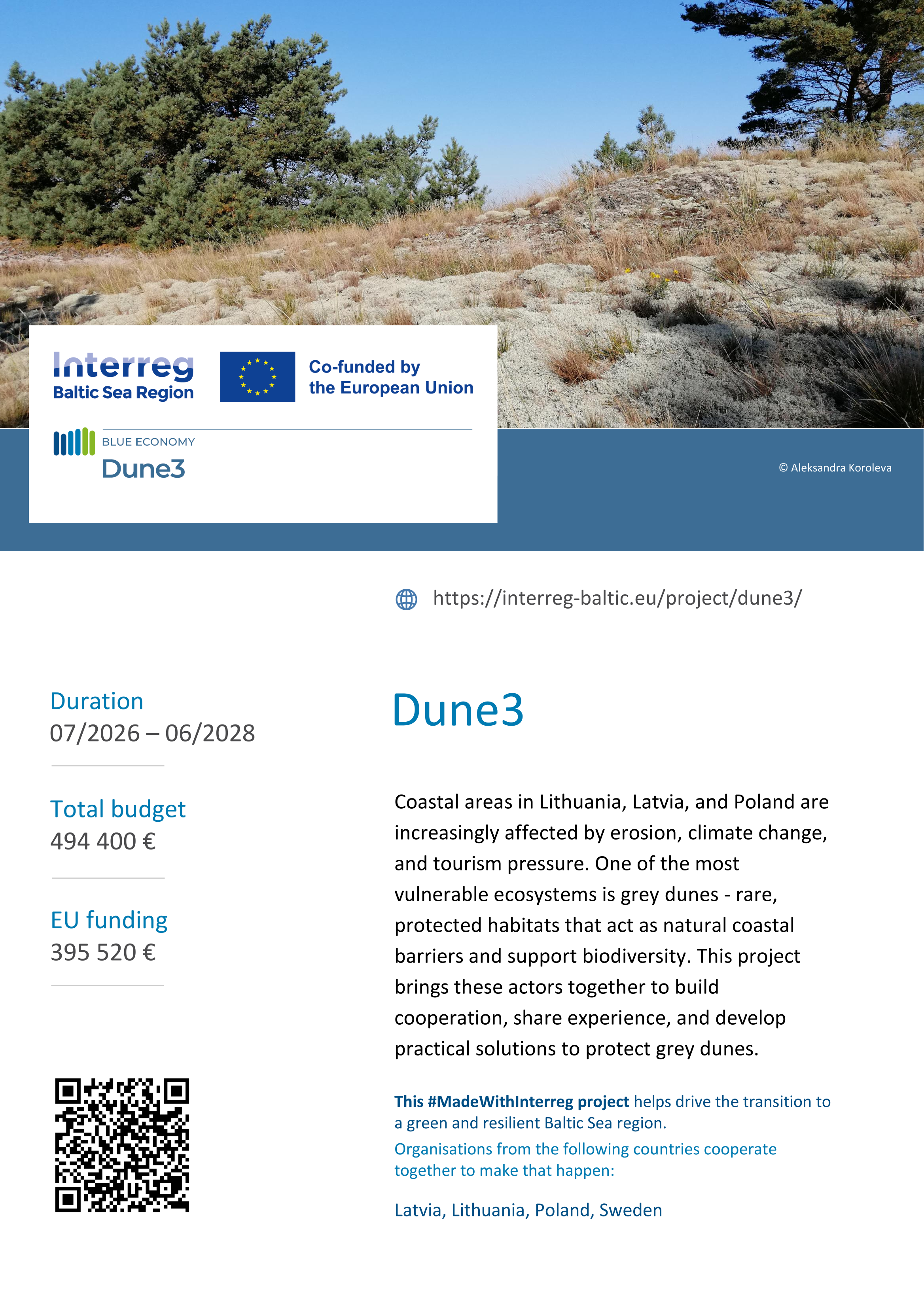
Coastal areas in Latvia, Lithuania and Poland are increasingly affected by coastal erosion, climate change and growing pressure from tourism and other human activities. Grey dunes – rare coastal habitats of high importance for biodiversity – are particularly vulnerable to these pressures. They form an important part of coastal ecosystems and landscapes, provide natural protection against erosion and storm impacts, and are also an important resource for nature-based tourism.
Municipalities, protected area managers and non-governmental organisations across the south-eastern Baltic Sea region face similar challenges in conserving and managing these habitats. However, grey dune restoration efforts remain fragmented, while coordinated approaches, tested practical solutions and opportunities for transnational knowledge and experience exchange are still limited.
Through the Interreg Baltic Sea Region project Dune3, six organisations from Latvia, Lithuania, Poland and Sweden bring together their knowledge and experience in coastal planning and management, nature conservation, habitat restoration, public engagement and environmental communication to address these shared challenges. Transnational cooperation will enable the partners to exchange knowledge and experience, harmonise grey dune restoration approaches and strengthen long-term cooperation across borders.
Project objective
The objective of Dune3 is to strengthen the protection and restoration of grey dunes along the south-eastern Baltic Sea coast by developing a joint approach to the management of these valuable habitats, testing practical restoration solutions and involving municipalities, protected area managers, non-governmental organisations and local communities.
The project will strengthen the knowledge, practical capacity and cooperation needed for the long-term conservation of grey dunes, while contributing to biodiversity conservation, coastal resilience, responsible tourism and the sustainable use of coastal resources.
Main activities and expected results
One of the key project results will be the Joint Baltic Grey Dune Restoration Plan, accompanied by country-specific annexes for Latvia, Lithuania and Poland. The Plan will bring together knowledge generated during the project, the experience of project partners and experts, and practical recommendations for the protection, restoration and long-term management of grey dunes.
To ensure that the proposed solutions are grounded in practical experience, pilot grey dune restoration activities will be implemented in Latvia and Lithuania. These pilots will test different restoration approaches in practice, assess their suitability and provide lessons that can be incorporated into the Joint Baltic Grey Dune Restoration Plan.
Public awareness and engagement will also form an important part of the project. Dune3 will produce a documentary film, information materials and podcasts, as well as citizen science materials and activities. These will help local communities, volunteers and coastal visitors better understand the importance of grey dunes and encourage wider public involvement in their conservation and monitoring.
The project will also promote responsible tourism and nature-friendly coastal management by raising awareness of how coastal areas can be used and enjoyed while safeguarding their natural values and ecosystem functions for future generations.
Project target groups and wider audiences
The main target groups of the Dune3 project are:
- municipalities and other local authorities, as well as grey dune landowners;
- sectoral authorities and agencies, including administrations and managers of coastal protected areas;
- non-governmental organisations, particularly environmental and nature conservation NGOs.
These groups play a direct role in the management, restoration and long-term protection of grey dune habitats.
In addition to the main target groups, the project’s public engagement, education and communication activities will also involve local communities and residents of coastal areas, volunteers and participants in citizen science activities, as well as tourists and other coastal visitors.
Project partners
The project is implemented by six organisations from four countries – Latvia, Lithuania, Poland and Sweden:
- Kurzeme Planning Region, Latvia – Lead Partner;
- Latvian Green Movement, Latvia;
- EUCC Baltic Office, Lithuania;
- Lithuanian Fund for Nature, Lithuania;
- “Nerush Natura” Foundation, Poland;
- Coalition Clean Baltic, an international network of environmental NGOs, with its secretariat based in Sweden, working to protect and improve the environment and natural resources of the Baltic Sea region.
The partnership combines expertise in regional and coastal planning and management, biodiversity conservation, ecological restoration, environmental education, citizen engagement and transnational cooperation.
Project funding
Total project budget: EUR 494,400
European Regional Development Fund (ERDF) co-financing: EUR 395,520
Total own contribution: EUR 98,880
Kurzeme Planning Region’s project budget is EUR 93,200, of which EUR 74,560 is co-financed by the European Regional Development Fund.
Additional information:
Aiga Meri
Head of Project Department
Kurzeme Planning Region
+371 29483674
aiga.meri@kurzemesregions.lv
This project is co-funded by the European Union through the Interreg Baltic Sea Region Programme. More information about the project is available on the Interreg Baltic Sea Region website: https://interreg-baltic.eu/project/dune3/