

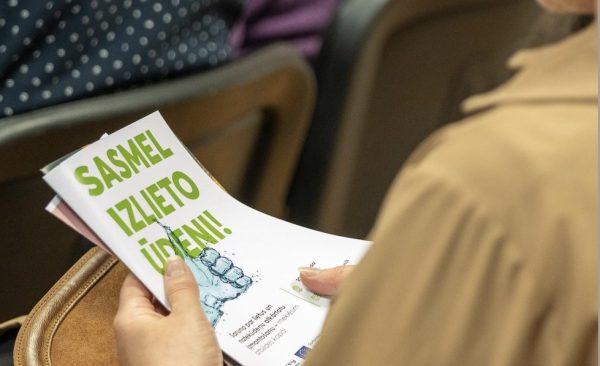
Educational discussions, expert insights and practical examples of how to make better use of rainwater in households, municipalities and businesses — this was the approach taken by the Kurzeme Planning Region in October and November, 2025, when implementing the information campaign “Collect the Used Water!”
The aim of the campaign was to remind people that even in the Baltic Sea Region, drinking water is a valuable resource, and that everyone must look for ways to conserve it by using available rainwater and treated wastewater.


The campaign was implemented within the framework of the Interreg Baltic Sea Region Programme project WaterMan, with the objective of strengthening public awareness of sustainable water management and encouraging people to introduce practical solutions in their everyday lives. Climate change is causing increasingly variable weather conditions, resulting in both prolonged droughts and excessive rainfall, which threaten water availability and quality. As a result, the issue of smart water use is becoming ever more important across the region.
Aija Neilande, Project Manager of WaterMan at the Kurzeme Planning Region, emphasises:
“Today, we rarely stop to think that the demand for drinking water is also increasing in the Baltic Sea Region, while rainwater and treated wastewater are often not used to their full potential. These water sources can be used in situations where drinking-quality water is not required — for toilet flushing, street and equipment washing, or irrigation — which is both more sustainable and more environmentally friendly.
Through this information campaign, we encouraged people not only to reflect on water recycling — in households, farms and businesses — but also to explore practical solutions. The more people understand these opportunities and their importance, the easier it will be for municipalities to implement sustainable water management solutions with public support. Our goal is to shape awareness and attitudes that help ‘collect the used water’ — both literally and symbolically — so that in the future water is used more wisely, responsibly and with respect for the environment.”
Campaign Activities
The information campaign was designed to educate residents of Kurzeme as well as the wider population of Latvia, along with entrepreneurs and municipal representatives, about sustainable water use. Therefore, it was implemented in Latvian, and all campaign content was produced in the Latvian language
The campaign included:
- A discussion event in Saldus on rainwater and wastewater recycling, with participation from Oskars Purmalis (Head of the Environmental Technology Laboratory, University of Latvia), Jurijs Kondratenko, Jānis Blūms (Head of the Water Management Sector at SIA Saldus Komunālserviss), and more than 50 participants from across Kurzeme;
- Educational content for private individuals and businesses, including animations, infographics and articles with practical guidance, featuring solutions such as rain gardens (bioswales), water retention ponds and permeable surfaces that help use rainwater more efficiently and reduce flood risks;
- Video stories presenting the experiences of municipalities, entrepreneurs and residents in water recycling, featuring Gita Rubežniece-Zute (Deputy Head of Kuldīga Development Agency), Kaspars Valdmanis (Technical Manager of shopping centres Spice and Spice Home), and Saldus resident Ināra Kacuba;
- Cooperation with social media opinion leaders Kristīne and Kaspars Virsnītis (@villa_ape) and Lelde Feldmane-Zajarska (@lauku_dzives_garsa), who shared their own practical examples of rainwater use;
- Promotion of the digital tool “Water Recycling Toolbox” — an online platform that brings together methodological guidance and practical examples from Baltic Sea Region countries on implementing water recycling solutions.
All campaign materials are available at Kurzemes Planning Region web page: https://kurzemesregions.lv/waterman-projekta-informativas-kampanas-sasmel-izlieto-udeni-materiali/
The campaign highlighted both the benefits of recycling rainwater and treated wastewater and the challenges associated with introducing such solutions in municipalities and businesses.
“To effectively implement rainwater and wastewater recycling solutions, the Cabinet of Ministers should classify these projects as nationally important measures that support climate change adaptation. With such political backing, municipalities and other project implementers would find it much easier to introduce valuable solutions,” explains Gita Rubežniece-Zute, representative of Kuldīga Municipality and Deputy Head of Kuldīga Development Agency.
Campaign ambassador and host of the Saldus event Kristīne Virsnīte adds:
“Participating in the WaterMan information campaign gave my husband and me the opportunity to learn about rainwater recycling options that are particularly relevant as we renovate our family home in Ape. My husband had already been considering installing a rainwater collection system for watering plants, but through the campaign we realised that we could create a pond on our property — which will not only be a beautiful feature in the garden, but also allow us to save drinking water and irrigate plants with natural water enriched with organic matter.”
The Kurzeme Planning Region plans to continue implementing similar projects and initiatives in the future to raise public awareness and encourage action, helping people adapt to climate change and use resources more wisely and responsibly in everyday life.
About the “WaterMan” project
Due to climate change, periods of drought are becoming more frequent in the Baltic Sea Region, and drinking water – mainly sourced from groundwater – can become scarce. For this reason, it will be necessary to use water of different qualities and tap into additional sources of “usable water” in the future.
WaterMan (Promoting water recycling in the Baltic Sea Region through capacity building at the local level) is implemented within the Interreg Baltic Sea Region Programme 2021–2027 and supports municipalities and water companies in adapting their strategies by developing practical solutions for water recycling and recirculation. Through region-specific approaches and real-life pilot measures, the project helps make local water supply systems more climate resilient.
More information: https://interreg-baltic.eu/project/waterman/
This publication has been prepared within the framework of the project implemented by the Kurzeme Planning Region: WaterMan – Promoting water recycling in the Baltic Sea Region through capacity building at local level. The project is co-financed by the European Union (European Regional Development Fund) and is implemented under the Interreg Baltic Sea Region Programme 2021–2027.