


In the past, the car park in front of the indoor swimming pool in Braniewo, Poland, was heavily sealed – an urban heat island in summer and, in spring, an exacerbating factor for flooding. Today, a rain garden stores water, cools the surroundings and enhances the area. Simple, important and transferable across the entire Baltic Sea Region.
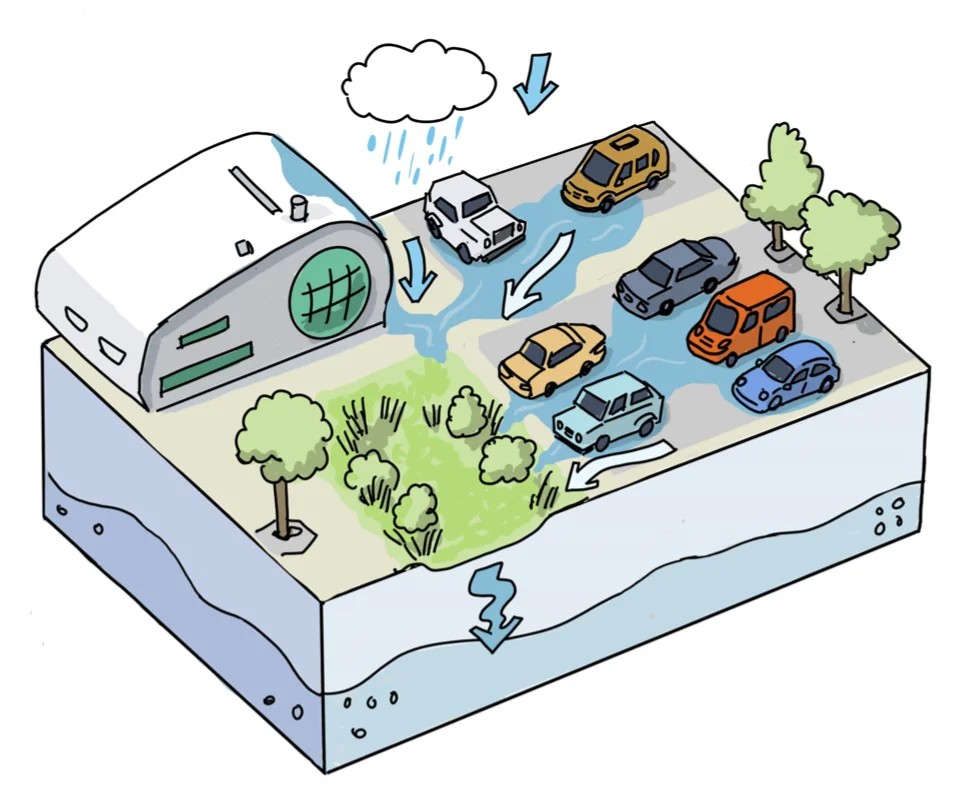
Completed in late summer 2025, the rain garden in the middle of the indoor pool’s car park immediately catches the eye. With its naturally shaped topography of gently contoured basins and long, stone-lined depressions planted with perennials, it is not only visually attractive but also highly functional. When the first heavy rain arrived again in mid-September, Jerzy Butkiewicz hurried to the site. As the municipal water lead who has overseen the WaterMan project in Braniewo from day one, he knew exactly what he wanted to see. And there it was: water flowing from the surrounding asphalt through designated openings in the kerb and collecting in the basins, where the soil matrix stores it and gradually releases it into the groundwater.
Consistently Putting the Obvious and Proven into Practice
Sometimes progress is not found in the newest technology but in the courage to tackle the obvious and proven – and to implement it well. In Braniewo, a small town in northern Poland, the rain garden in the car park of the municipal indoor swimming pool “Zatoka” is not a spectacular high-tech project, but a visible measure with real impact.
The starting point was everyday urban management. The pool is surrounded by concrete surfaces and asphalted car parks – a setting that has become increasingly problematic with climate change. In summer, temperatures here could exceed 40°C. During heavy rain, water flowed straight from the asphalt into the sewer system and onward to the flood-prone Pasłęka River. At the same time, the few existing green islands visibly withered during dry spells unless they were watered regularly with valuable drinking water.
Braniewo’s rapid shift from municipal debate to decisive action was driven by growing optimism about water recycling and a fortunate alignment of factors. The Institute of Civil and Environmental Engineering at Gdańsk University of Technology, led by Professor Magdalena Gajewska and involved in the WaterMan project, identified the indoor pool as an ideal site for two pilot measures: the world’s first facility for recycling swimming-pool backwash water and, next door, a rain garden as a nature-based solution. High-tech at one end, low-tech at the other – two complementary approaches to strengthening urban water resilience. Jerzy Butkiewicz coordinated both measures on site and became the local driving force behind their realisation.
Using the Existing Topography Wisely
Together with Butkiewicz, Gajewska and her research team developed the rain garden concept for the car park. Rain gardens retain stormwater on site and allow it to infiltrate gradually into the soil. This reduces pressure on sewer systems, irrigates vegetation and cools the microclimate.
Despite being a well-established concept, rain gardens are not plug-and-play solutions. “Every site brings different requirements, from soil and slope to water flows,” explains Gajewska. Achieving the desired storage and cooling effects requires careful design, nature-based planning, plant diversity and hydrological elements such as retention swales and sediment barriers. “The trick is to make smart use of the existing topography. Ideally, you place a rain garden where there is already a slight gradient.” This was exactly the case at the Zatoka car park.
The planning and construction process was not without friction. Technical details such as trough heights and the use of large natural stones instead of concrete were debated intensively between the university and landscape contractors. As on-site coordinator, Butkiewicz ensured communication between all parties and helped translate theory into practice. The pilot was deliberately tested under real-world conditions with the aim of learning from it and transferring the concept elsewhere.
Today, the site includes a flower meadow of around 400 m², a 210 m² retention bed with additional planting, greened lampposts, a planted retaining wall and new green islands.
An Ideal Location for Communication and Education
The location was chosen not only for its natural slope and proximity to the pool-water recycling pilot, but also for its high visibility. Many residents and visitors pass through the indoor pool every day, and school classes regularly come for swimming lessons.
New information boards explain infiltration, evaporation and water cycles. They also highlight why the large natural water cycle increasingly needs to be complemented by small, local water-recycling loops to adapt to climate change. Further educational activities, such as a family picnic around the rain garden, are planned.
“What we are showing here is that you can get started without huge investments or years of planning,” says Gajewska. “The elements are simple, the technology is available, and the impact is immediately measurable.” For Braniewo, the goal is not only to retain water, but also to inspire interest in smart, practical solutions that help keep urban spaces green and liveable without wasting drinking water.
Implementing the rain garden and the swimming-pool water recycling pilot side by side increases visibility and demonstrates a holistic approach to urban water resilience.
A Practical Invitation to Other Cities
Often, large infrastructure projects are not required. Sometimes, a few small measures are enough to make a difference. A rain garden in a car park, a modest budget, thoughtful planning and cooperation can already create tangible benefits.
It is a scalable, transferable approach – and a practical invitation for other cities simply to go ahead and get started.
Want to Learn More?
Additional information on this Braniewo pilot measure is available in the Water Recycling Toolbox, developed within the WaterMan project:
https://www.eurobalt.org/waterrecyclingtoolbox/use-cases/braniewo-rain-garden-for-the-greening-of-a-public-car-park/
About the “WaterMan” project
Due to climate change, periods of drought are becoming more frequent in the Baltic Sea Region, and drinking water – mainly sourced from groundwater – can become scarce. For this reason, it will be necessary to use water of different qualities and tap into additional sources of “usable water” in the future.
WaterMan (Promoting water recycling in the Baltic Sea Region through capacity building at the local level) is implemented within the Interreg Baltic Sea Region Programme 2021–2027 and supports municipalities and water companies in adapting their strategies by developing practical solutions for water recycling and recirculation. Through region-specific approaches and real-life pilot measures, the project helps make local water supply systems more climate resilient.
More information: https://interreg-baltic.eu/project/waterman/